
The POWER Playbook: What It Takes to Win in Digital Marketing

Football season is back, which means playbooks are getting complicated, fantasy lineups are being overanalyzed, and everyone suddenly has an opinion on who the GOAT is.
Naturally, we started thinking about marketing.
Welcome to the POWER Playbook: our breakdown of what it takes to compete, adapt, and win in digital marketing today.
Because the marketing landscape is changing fast. AI is reshaping advertising and search. Platforms are automating more campaign decisions. Organic content has to work harder to earn attention. Tracking and attribution are becoming increasingly important. And businesses have more tools, platforms, and data at their disposal than ever before.
The old playbook simply isn't enough.
Winning in digital marketing requires a clear strategy, adaptable execution, strong creative, reliable data, the right technology, and most importantly, a team that is constantly learning.
First, You Need a Game Plan
You can have an incredibly talented roster and still lose games without a strategy. Marketing works the same way. Before launching an ad, writing a social post, rebuilding a website, or setting up an email automation, you need to understand the bigger picture:
What are we trying to accomplish?
Who are we trying to reach?
What does success actually look like?
And how does every marketing channel contribute to that goal?
At POWER, that direction starts with leadership. Our CEO, Colton Hower, plays the role of head coach, helping establish the broader business strategy while ensuring our team understands where we're going and why.
But the bigger lesson applies to any organization: tactics should follow strategy, not replace it.
A business running Google Ads, posting five times a week, and sending emails isn't necessarily executing a marketing strategy. Those efforts become more powerful when they work together toward the same objective.
Your Offense Needs to Be Able to Adjust at the Line

In today's advertising environment, running the same play over and over isn't going to cut it. Platforms change. Competition changes. Consumer behavior changes. Search changes. Your paid media strategy has to change with them.
AI is also increasingly being embedded in the platforms marketers use every day, with Google expanding AI-powered advertising and analytics, while Meta uses AI systems for delivery and optimization.
Here at POWER, we recognize this change, but know that throwing your campaign to AI and hoping for the best isn’t a strategy. Instead, AI is part of your equipment. The advantage comes from knowing how and when to use it.
That's why our ads team is constantly testing new creative, analyzing campaign performance, experimenting with platform capabilities, refining targeting and adjusting strategy based on what the data is telling us.
If we're assigning football positions, our paid media team gets wide receiver.
They're responsible for creating opportunities for big plays, but those big plays don't happen by accident. They're built on preparation, testing, timing, and execution.
You Need Creative That Can Find an Opening
Paid advertising can generate immediate opportunities, but brands also need an organic presence that people actually want to engage with. That's where social comes in.
Our social team is the running back: constantly looking for openings, adapting in real time, and finding a way to keep moving the brand forward. And those openings are changing.
Meta reported that by Q4 2025, 75% of Instagram recommendations in the U.S. were coming from original posts, while the company continued investing heavily in recommendation technology across its platforms.
For marketers, that's another reminder that simply being on social isn't enough. Brands need something worth paying attention to.
That means understanding platform trends without copying everyone else. It means adapting content to each audience. It means finding ways to educate, entertain, build credibility, and communicate an actual personality.
Sometimes that's a thoughtful educational post. Sometimes it's a behind-the-scenes look at your company. And sometimes it's the marketing equivalent of Saquon Barkley leaping backwards over a defender.
For our client Joe Knows Hospitality, for example, we saw that adding audio to carousels amplified their discoverability, building excitement through music for upcoming concert posts. Implementing this strategy helped increase our reach by 49.8% for the month of August.
While the format can change, the job stays the same: earn attention and move the brand forward.
Don't Ignore Special Teams: Your Website, CRM and Email Matter
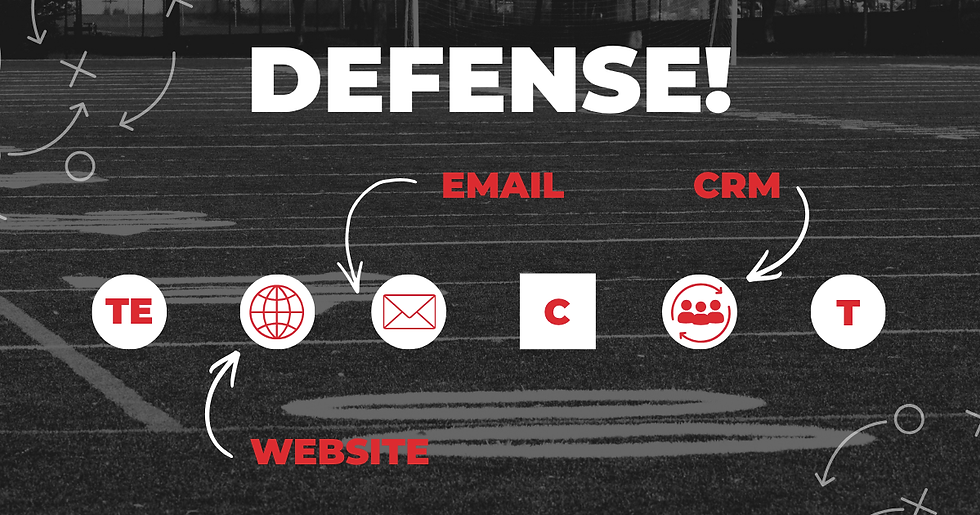
Paid media and organic social tend to get the highlights. But championships aren't won on highlight reels alone.
Your website, CRM, email marketing, analytics, and conversion infrastructure may not always be the flashiest parts of your marketing strategy, but they can determine whether all that attention you're generating actually turns into business.
That's why we think of these channels as special teams. They have jobs to do that are easy to overlook…until something goes wrong.
You can run an incredible ad campaign, but if it sends prospects to a confusing website, you're leaving opportunities on the field. You can generate hundreds of leads, but without a CRM strategy and reliable follow-up process, leads get lost. You can build a database of customers, but without segmentation and thoughtful email marketing, you're missing opportunities to nurture those relationships.
Modern marketing works best as a connected system.
At POWER, our web, CRM, email, paid media, social, and strategy teams don't operate on separate islands. We work cross-functionally so that each part of the customer journey supports the next.
Great Teams Play Defense, Too
Growth gets most of the attention in marketing. But sustainable growth also requires protecting what you've built.
For us, defense means strong internal operations, reliable tracking, quality control, documented processes, communication, and a team that can identify problems before they become bigger problems. As marketing platforms become more automated, the quality of the information feeding those systems also matters more.
That's why staying ahead also means regularly improving the less-visible parts of marketing: tracking, reporting, dashboards, attribution, CRM data, internal workflows, and communication between teams.
At POWER, we've continued improving those systems as we've grown to serve more than 200 clients.
Growth without processes creates chaos. Growth supported by the right systems creates momentum.
Then, Get in the Film Room
One of the most valuable habits in football happens after the game. Teams watch film. They look at what worked. They look at what didn't. They identify opportunities. Then they change the next game plan accordingly.
Marketing teams should do the same thing. As Jalen Hurts said after Super Bowl LVII: “You either win or you learn.”
That's a mindset we believe in at POWER.
Campaign didn't perform the way we expected? Find out why.
New ad format launches? Test whether it makes sense for our clients.
A platform algorithm shifts? Understand what's changing.
A process internally creates friction? Fix it.
A campaign crushes expectations? Figure out what contributed to the result, and whether we can apply that learning somewhere else.
The agencies and brands that succeed over the next several years won't necessarily be the ones using the most AI tools, publishing the most content, or spending the most money on ads. They'll be the ones that can learn faster, adapt faster, and execute better.
The Tools in Our Playbook
Of course, every team needs equipment. Our toolkit continues to evolve, but today it includes platforms and technology across the entire marketing ecosystem:
Creative: Canva and other content-development tools
Paid Media: Google Ads, Meta Ads, Linkedin Ads
Measurement: Google Analytics, reporting, dashboards, and data visualization
Conversion: Website development and optimization
Customer Relationships: CRM, automation, and email marketing platforms
Collaboration: Slack and Google Workspace
Execution: Project management and workflow tools
AI: Tools that help our team research, analyze, automate, ideate, and work more efficiently
But here's the important part:
The tools aren't the playbook. Anyone can open a Google Ads account. Anyone can buy software. Anyone can ask AI to generate something. Competitive advantage comes from the people using those tools, the strategy behind them, the processes connecting them, and the willingness to keep improving.
That's the POWER Playbook. Build the right team. Develop the right systems. Pay attention to what's changing. Test new opportunities. Measure the results. Learn from every snap.
Then run the next play better.
Ready to Take Your Marketing to the Next Level?
Digital marketing will keep changing. Your business needs a team that changes with it.
At POWER, we don’t settle for a .500 record (Sorry Mike Tomlin). We're constantly evolving our strategies, technology, processes, and expertise so our clients are prepared for where it's going next.
Ready to build your winning game plan? Contact POWER Marketing and let's get to work.


